
Metropolitan Transition Center Overview
Metropolitan Transition Center, often shortened to MTC, is operated by the Maryland Department of Public Safety and Correctional Services Division of Correction. DPSCS places MTC within the Baltimore City correctional complex, but its function is different from Baltimore Central Booking and Intake Center. BCBIC is the practical first stop for many new Baltimore City arrests. MTC is a state correctional facility tied to transition, reentry, general population custody, and hospital population visitation categories.
The facility address is 954 Forrest Street, Baltimore, MD 21202. The phone number documented in the research is 410-230-1400. Because the Madison Street and Greenmount area contains multiple facilities within a short distance, visitors and families should confirm that the person is actually assigned to Metropolitan Transition Center before using an address, scheduling a visit, mailing funds, or sending correspondence.
The official DPSCS Metropolitan Transition Center page is the source for the facility-specific visitor instructions captured for this build. It distinguishes general population and hospital population visiting rules and explains that visits alternate by week between in-person and video formats. That distinction is central to MTC because a person listed in state custody may have visiting limits based on population category rather than simply the facility name.
The captured MTC official page shows visitation scheduling instructions and the email route for visits. The screenshot below comes from that official DPSCS location page and should be used as a starting point before a trip or visit request.
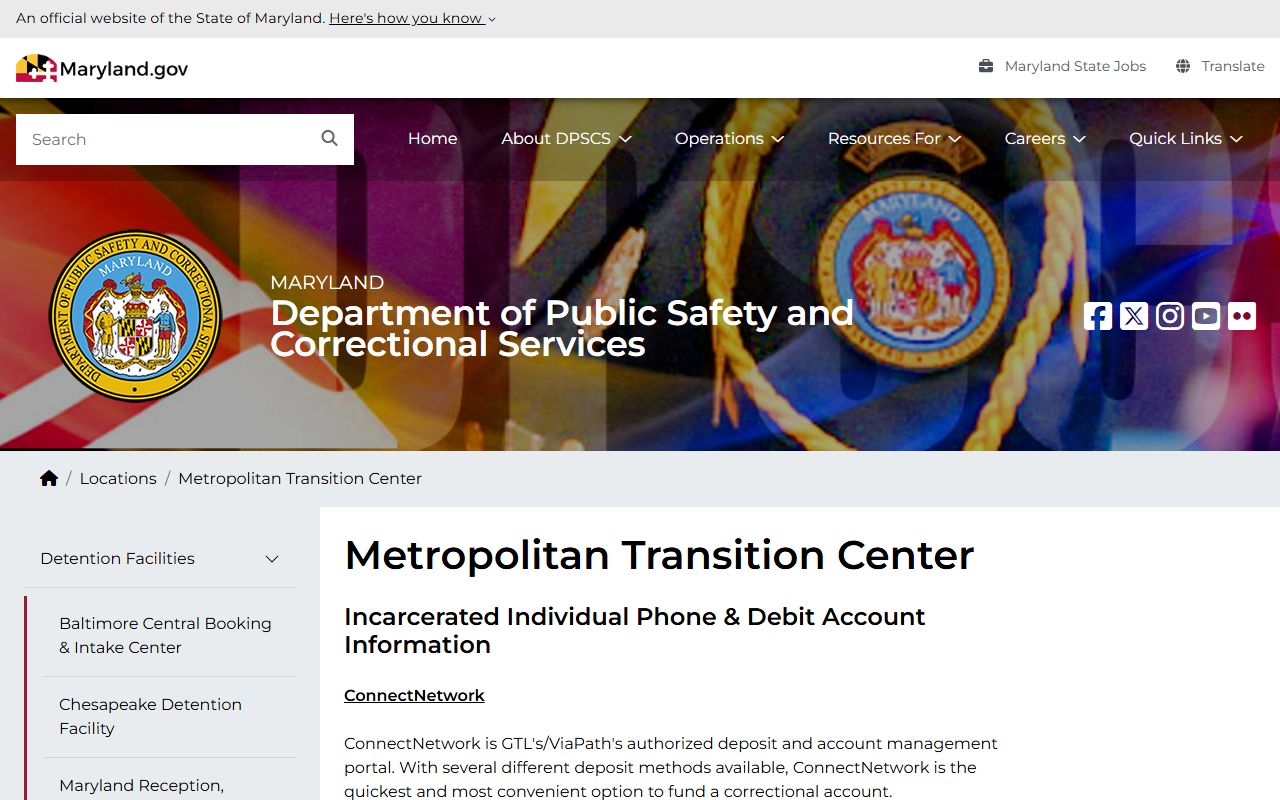
The image reflects the facility-specific DPSCS page, while custody lookup should still be routed through the statewide DPSCS incarcerated individual locator when the person is in covered Maryland state custody.
Metropolitan Transition Center Capacity and Population
A 2022 PREA audit listed Metropolitan Transition Center with a designated capacity of 624, an average daily population of 597, and 10 housing units. Those numbers are audit-based, so they should be read as a sourced operational snapshot rather than a promise that today's count is identical. DPSCS population can change through transfers, court commitments, releases, medical movements, classification decisions, and statewide housing changes.
MTC should not be mixed into one simple Baltimore City jail population total. It is part of Maryland state correctional custody, while BCBIC is a pretrial intake facility, Youth Detention Center serves youthful detainees, Baltimore City Correctional Center is minimum, pre-release, and work release, and Chesapeake Detention Facility has federal detention functions. Combining those unlike populations would blur the practical lookup path.
How to Look Up an Inmate at Metropolitan Transition Center
Use the DPSCS Incarcerated Individual Locator for someone who may be committed to the Commissioner of Correction and housed in a Division of Correction facility such as MTC. The locator is not a live Baltimore City booking log. DPSCS states that it does not provide information on everyone in DPSCS custody, may omit some short-sentenced people in Division of Pretrial Detention and Services facilities, and does not show people no longer in custody due to release or escape.
- Open the DPSCS Incarcerated Individual Locator and search by the person's legal first and last name.
- Review the housing location result and confirm that it identifies Metropolitan Transition Center or another Maryland facility.
- If the person was arrested very recently in Baltimore City, call Baltimore Central Booking and Intake Center detainee service numbers instead of relying only on the state locator.
- Use Maryland Judiciary Case Search for public court charges, court dates, case status, and dispositions when a court case is public.
- Use Maryland VINE for custody or case notifications, then verify important details with DPSCS.
Lookup distinction: MTC is a state correctional facility. Do not treat it as the source for a same-day Baltimore City arrest roster or an adult booking mugshot gallery.
Metropolitan Transition Center Address and Contact
Contact the facility before travel, mail, money deposits, or visit scheduling because the MTC visiting process uses population categories and approval steps. A caller should have the person's full legal name, SID if known, date of birth if appropriate, and any court case number available from Maryland Case Search.
Metropolitan Transition Center
954 Forrest Street
Baltimore, MD 21202
410-230-1400
State correctional facility operated by Maryland DPSCS Division of Correction.
Visit Scheduling
MTC.INMATEVISITATION@MARYLAND.GOV
Include incarcerated person's first and last name, SID, and each visitor's first and last name.
Allow 24 to 48 hours for a response as stated in the captured DPSCS instructions.
Visiting Someone at Metropolitan Transition Center
MTC visitation alternates weekly between in-person and video visits. The official instructions captured in the research allow one visit per week. General population visits run Thursday through Sunday, children are allowed, and the maximum is three visitors including children. Hospital population visits are Saturday or Sunday, children are not allowed, and the maximum is two visitors. In-person visits are 30 minutes.
General DPSCS visiting rules still apply. Visitors to correctional facilities must clear screening, may be subject to canine, electronic drug detection, or visual searches, and visitors age 16 or older need valid state-issued photo identification. Cell phones, tobacco products, and electronic devices must be secured outside the visiting area. Prior arrest histories may be reviewed, so visitor approval should be confirmed before arrival.
| Population | Days | Visit Type and Limits |
|---|---|---|
| General population | Thursday through Sunday | Alternates weekly between in-person and video; one visit per week; maximum three visitors including children. |
| Hospital population | Saturday or Sunday | Alternates weekly between in-person and video; one visit per week; no children; maximum two visitors. |
| In-person visit length | Scheduled visit day | 30 minutes according to the captured DPSCS MTC instructions. |
Mail, Phone, and Money at Metropolitan Transition Center
DPSCS mail, phone, package, and banking rules apply to MTC unless the facility gives a more specific instruction. For mail, use the incarcerated individual's name, SID if known, facility name, and facility address, then verify any current scanning, book, package, or vendor rules before sending items. Do not assume that a package accepted at one DPSCS facility will be accepted at MTC.
DPSCS phone services identify ConnectNetwork, also known as GTL or ViaPath, as the authorized deposit and account management portal for phone accounts. DPSCS states that it does not set up phone accounts directly. ConnectNetwork support is listed in the research as 877-650-4249, and the services include AdvancePay prepaid telephone accounts and PIN Debit.
For money, DPSCS uses the Maryland Offender Banking System. For lockbox facilities, money orders go to P.O. Box 17111, Baltimore, MD 21297-0382. The money order must include the incarcerated individual's name, facility name or abbreviation, SID, and the sender's correct name and address. DPSCS says correctly submitted funds usually post in 2 to 7 business days from receipt and processing, may take up to 10 days with mail delivery, and money orders of $250 or more are held for 30 days.
| Service | Provider / Detail |
|---|---|
| Mail Address | Use name, SID, Metropolitan Transition Center, 954 Forrest Street, Baltimore, MD 21202, and verify current DPSCS mail rules. |
| Phone | ConnectNetwork/GTL/ViaPath account services; DPSCS does not create phone accounts for families. |
| Money Deposit | Maryland Offender Banking System lockbox money orders to P.O. Box 17111, Baltimore, MD 21297-0382. |
Transfers, Reentry, and State Custody at Metropolitan Transition Center
MTC is not the ordinary booking desk for a new Baltimore City arrest. Booking and early pretrial processing usually route through BCBIC or another DPSCS pretrial facility. A person at MTC is more likely to be in a state correctional placement, transition function, reentry pathway, general population assignment, or hospital population category. Court records may still explain the sentence, charge history, or release conditions, but the facility role is state correctional custody rather than street-arrest intake.
DPSCS reentry information states that reentry services begin upon intake and are provided to incarcerated individuals in all facilities and all security levels. The Reentry Unit aims to identify reentry plans within six months of release from the DPSCS system. That statewide statement fits MTC's transition-center role, but individual program access depends on classification, sentence status, medical issues, and facility approval.
About Metropolitan Transition Center
MTC sits within Baltimore City's dense correctional corridor near other DPSCS facilities. The local geography makes accurate facility identification especially important. BCBIC, MRDCC, BCCC, YDC, CDF, and MTC are all close enough that a visitor can confuse them if relying only on a broad phrase like Baltimore jail. MTC's address on Forrest Street and its transition, reentry, and hospital-population visitor rules are the clearest practical separators.
Recent statewide DPSCS context includes an official 2025 body-worn camera pilot announcement and facility planning related to Maryland Correctional Institution-Jessup. Those statewide items do not change the address or visitor rules for MTC, but they show why state custody status and facility assignments should be checked close to the date of a visit.
Note: Confirm custody, population category, and visit approval with DPSCS before traveling to MTC or sending money.